

Introduction
Passive transport is one of the most important biological processes that keeps living cells functioning properly. Every second, billions of molecules move into and out of cells without requiring any energy from the cell itself. This movement is known as passive transport, and it plays a critical role in maintaining balance, delivering nutrients, removing waste, and supporting countless life-sustaining activities.
Whether you’re a biology student, a healthcare professional, or simply someone interested in understanding how the human body works, learning about passive transport provides valuable insight into the incredible efficiency of living organisms. Although the concept may sound scientific at first, it is actually based on a simple principle: molecules naturally move from areas where they are more concentrated to areas where they are less concentrated.
In this guide, we’ll explore passive transport in detail, discuss its different types, explain why it is essential, compare it with active transport, and examine real-life examples that make this fascinating biological process easier to understand.
What Is Passive Transport?
Passive transport is the movement of substances across a cell membrane without the use of cellular energy, commonly in the form of ATP. Instead of consuming energy, molecules move naturally because of differences in concentration between two areas. This movement continues until equilibrium is reached, meaning the concentration becomes balanced on both sides of the membrane.
The cell membrane acts as a selective barrier that controls which substances can enter or leave the cell. While some molecules can pass through easily, others require specific protein channels or carrier proteins. Regardless of the pathway they use, passive transport always follows the concentration gradient, meaning substances move from high concentration to low concentration.
This natural movement allows cells to perform essential functions while conserving energy. Since cells do not need to expend ATP for passive transport, they can reserve energy for more demanding tasks such as growth, repair, muscle contraction, and active transport.
How Passive Transport Works
To understand passive transport, imagine spraying perfume in one corner of a room. At first, the scent is strongest near the spray, but gradually it spreads throughout the room until the smell is evenly distributed. Molecules behave similarly inside living organisms.
Every molecule possesses kinetic energy, causing it to move randomly. When there is a higher concentration of molecules in one area, the random movement results in more molecules traveling toward areas where fewer molecules exist. Over time, this movement naturally balances the concentration.
Cell membranes are specially designed to support this process. Small, nonpolar molecules such as oxygen and carbon dioxide pass directly through the membrane, while larger or charged molecules often require membrane proteins that provide a safe passage without consuming energy.
Types of Passive Transport
Passive transport consists of several distinct mechanisms, each serving a specific purpose depending on the type of molecule involved.
Simple Diffusion
Simple diffusion is the most basic form of passive transport. In this process, molecules move directly through the phospholipid bilayer of the cell membrane without assistance from transport proteins. This method works best for small, nonpolar molecules.
Oxygen and carbon dioxide are excellent examples of substances that move through simple diffusion. Oxygen enters cells where it is needed for respiration, while carbon dioxide leaves cells as a waste product. Both gases move according to their concentration gradients.
Simple diffusion is efficient because it requires no additional structures or energy. As long as a concentration difference exists, molecules continue moving until equilibrium is achieved.
Facilitated Diffusion
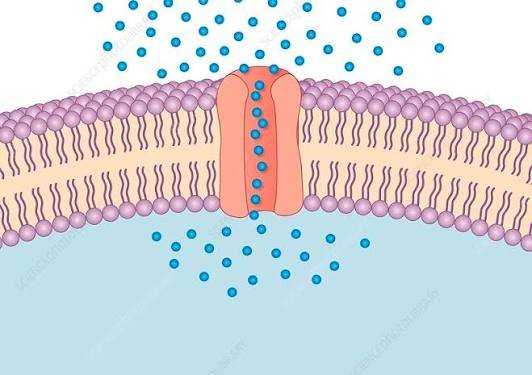
Some molecules are too large or carry electrical charges, making it difficult for them to pass through the membrane directly. Facilitated diffusion solves this problem by using specialized transport proteins embedded within the cell membrane.
Channel proteins create tiny openings that allow ions and water molecules to move through the membrane. Carrier proteins temporarily bind to specific molecules, change shape, and transport them across the membrane.
Despite using proteins, facilitated diffusion remains a passive process because molecules continue moving down their concentration gradient without ATP. Glucose entering many body cells is a common example of facilitated diffusion.
Osmosis
Osmosis is the passive movement of water molecules across a selectively permeable membrane. Water moves from regions with lower solute concentration to regions with higher solute concentration until equilibrium is established.
This process helps regulate the water balance inside cells. If too much water enters a cell, it may swell. If excessive water leaves the cell, it can shrink. Maintaining the proper balance is essential for healthy cell function.
Plants rely heavily on osmosis to maintain turgor pressure, which keeps stems upright and leaves firm. In animals, osmosis supports normal blood circulation, kidney function, and hydration.
Factors That Affect Passive Transport
Several factors influence how quickly passive transport occurs. One of the most important is the concentration gradient. The greater the difference in concentration between two areas, the faster molecules move across the membrane.
Temperature also plays a significant role. Higher temperatures increase molecular movement, allowing substances to diffuse more rapidly. Lower temperatures slow molecular motion and reduce the rate of passive transport.
The size of molecules and the properties of the membrane also matter. Small molecules generally move faster than larger ones, while membranes with greater permeability allow substances to pass more easily. Membrane surface area and thickness further influence transport efficiency.
Importance of Passive Transport in Living Organisms
Passive transport is essential for maintaining life because it enables cells to exchange materials efficiently without wasting valuable energy. Every living organism depends on this process for survival.
Human cells continuously receive oxygen through passive transport while simultaneously releasing carbon dioxide. Without this exchange, cellular respiration could not occur, and the body’s tissues would quickly become deprived of oxygen.
Passive transport also helps regulate water balance, maintain stable internal conditions, distribute nutrients, and remove waste products. Together, these functions contribute to overall health and proper organ function.
Passive Transport vs. Active Transport
Although passive transport and active transport both move substances across cell membranes, they differ in several important ways. The biggest difference is energy usage.
Passive transport does not require ATP because substances move naturally from high concentration to low concentration. Active transport, on the other hand, requires energy to move substances against their concentration gradient from low concentration to high concentration.
Another difference lies in their purpose. Passive transport helps maintain natural equilibrium, while active transport enables cells to accumulate essential nutrients or remove substances even when natural diffusion would not allow it. Both processes work together to maintain cellular homeostasis.
Real-Life Examples of Passive Transport
One of the best-known examples of passive transport occurs in the lungs. Oxygen from inhaled air diffuses into the bloodstream because its concentration is higher in the lungs than in the blood. Carbon dioxide simultaneously diffuses from the blood into the lungs to be exhaled.
Another excellent example is nutrient absorption in the small intestine. Certain molecules move into intestinal cells through facilitated diffusion, allowing nutrients to enter the bloodstream efficiently.
Water absorption by plant roots demonstrates osmosis in action. Water naturally moves from moist soil into root cells because the concentration of dissolved minerals inside the roots is higher than in the surrounding soil.
Advantages of Passive Transport
One major advantage of passive transport is energy conservation. Since ATP is not required, cells save valuable energy for other biological activities that demand greater resources.
Passive transport is also highly efficient for maintaining stable internal conditions. It continuously balances concentrations of important substances without requiring constant regulation or energy expenditure.
Another benefit is simplicity. The process operates naturally according to physical laws, allowing organisms to exchange gases, nutrients, and water quickly and reliably under normal conditions.
Common Misconceptions About Passive Transport
A common misconception is that passive transport means molecules stop moving once equilibrium is reached. In reality, molecules continue moving constantly, but they move equally in both directions, creating dynamic equilibrium.
Another misunderstanding is that all molecules can cross the cell membrane freely. In fact, many substances require channel proteins or carrier proteins because of their size or electrical charge.
Some people also assume that facilitated diffusion requires energy because it involves transport proteins. However, these proteins simply assist movement down the concentration gradient and do not consume ATP.
Conclusion
Passive transport is one of the most fundamental processes in biology, allowing cells to move substances efficiently without expending energy. By relying on natural concentration gradients, cells conserve resources while maintaining the balance needed for survival.
From simple diffusion and facilitated diffusion to osmosis, each type of passive transport serves a unique purpose in supporting healthy cellular function. These mechanisms help deliver oxygen, regulate water balance, distribute nutrients, and eliminate waste products throughout living organisms.
Understanding passive transport not only strengthens knowledge of biology but also highlights the remarkable efficiency of nature. Although invisible to the naked eye, this continuous movement of molecules powers countless biological processes that sustain life every single day. Whether studied in the classroom or applied in medicine and scientific research, passive transport remains a cornerstone of modern biological science.
You May Also Read : Indeed Jobs