
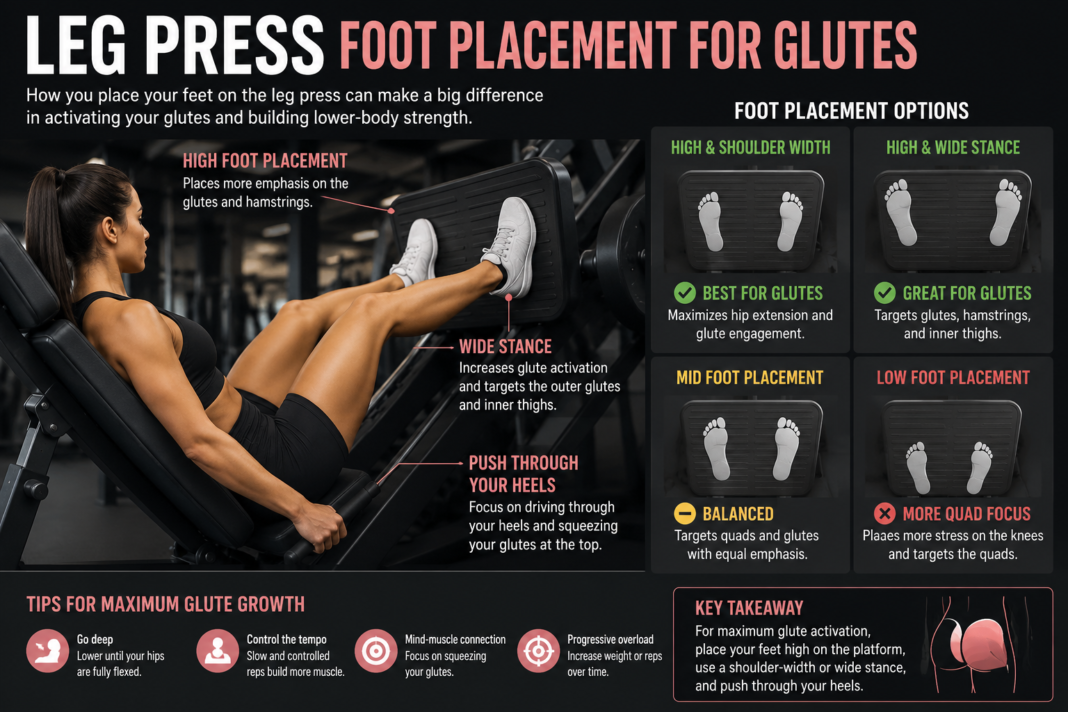

Building stronger, fuller glutes is one of the most common fitness goals among gym-goers today. While exercises like squats, hip thrusts, and lunges often receive the spotlight, the leg press remains one of the most effective machines for developing lower-body strength and muscle mass.
The key to unlocking its full potential lies in understanding leg press foot placement for glutes. Small adjustments in where you position your feet on the platform can dramatically change which muscles work hardest during each repetition. When performed correctly, the leg press can become a powerful glute-building exercise that complements your overall training program.
This comprehensive guide explores everything you need to know about optimizing foot placement, improving glute activation, avoiding common mistakes, and maximizing long-term results.
Why Foot Placement Matters on the Leg Press
The leg press is a compound movement that involves multiple joints and muscle groups working together. Depending on your stance, the exercise can emphasize the quadriceps, glutes, hamstrings, or a combination of all three.
Foot positioning changes the angles at your hips and knees throughout the movement. These changes influence muscle recruitment patterns, making foot placement one of the most important variables for anyone focused on glute development rather than simply moving heavier weight.
Understanding Glute Anatomy and Function
The gluteal muscles consist of the gluteus maximus, gluteus medius, and gluteus minimus. The gluteus maximus is the largest and most powerful muscle, primarily responsible for hip extension and generating force during lower-body movements.
Because the glutes play a major role in extending the hips, exercises that create greater hip flexion and extension tend to stimulate them more effectively. This principle directly influences the best approach to leg press foot placement for glutes.
The Best Leg Press Foot Placement for Glutes
For most people, placing the feet higher on the platform is the most effective setup for glute emphasis. A high foot position increases hip flexion while reducing knee dominance, encouraging greater glute and hamstring involvement.
Position your feet approximately shoulder-width apart in the upper third of the platform. This arrangement allows for deeper hip movement throughout the range of motion while maintaining stability and safety during heavier sets.
High Foot Placement vs Low Foot Placement
A high foot placement shifts more work toward the posterior chain. The glutes and hamstrings become increasingly responsible for driving the weight upward from the bottom position.
A low foot placement typically increases knee flexion and quadriceps activation. While it remains an excellent strength-building variation, it generally does not produce the same level of glute emphasis as higher positioning on the sled.
Wide Stance Foot Placement and Glute Activation
Many lifters combine a high foot position with a moderately wide stance. This variation often increases glute engagement because the hips must work through a larger range of motion.
A wider stance can also improve comfort for individuals with limited ankle mobility. However, excessively wide positioning may reduce stability and place unnecessary stress on the hips if flexibility is lacking.
Narrow Stance Considerations
A narrow stance tends to shift emphasis toward the quadriceps. The movement becomes more knee-dominant and less reliant on hip extension.
While a narrow setup can still involve the glutes, it is generally not the preferred strategy when the primary goal is maximizing glute growth through leg press foot placement for glutes.
Foot Angle and Its Impact
Foot angle is another important but often overlooked factor. Slightly turning the toes outward can improve hip comfort and allow for a more natural movement pattern.
The ideal angle varies between individuals based on hip anatomy and mobility. Most people perform best with toes pointed outward approximately 10 to 30 degrees rather than perfectly straight ahead.
Comparing Different Leg Press Foot Placements
| Foot Placement | Primary Muscles Targeted | Glute Activation | Quad Activation | Best For |
| High and Shoulder Width | Glutes, Hamstrings | Very High | Moderate | Glute Growth |
| High and Wide | Glutes, Adductors, Hamstrings | High | Moderate | Posterior Chain Development |
| Mid Platform | Balanced Lower Body | Moderate | Moderate | General Strength |
| Low Platform | Quadriceps | Low | Very High | Quad Development |
| Narrow Stance | Quadriceps | Low to Moderate | High | Front Leg Strength |
| Wide Stance | Glutes and Inner Thighs | High | Moderate | Hip-Dominant Training |
Proper Setup for Maximum Glute Engagement
Before beginning the movement, position your lower back firmly against the seat. Your feet should remain flat on the platform throughout the entire repetition.
As you lower the sled, focus on bringing your knees toward your chest while maintaining spinal neutrality. This deeper hip bend creates the conditions necessary for stronger glute activation.
Range of Motion and Glute Development
Many people limit their range of motion unnecessarily. While partial repetitions allow heavier loads, they often reduce the stretch experienced by the glutes.
A controlled, deep range of motion typically produces better muscle-building outcomes. Lower the weight as far as mobility safely allows without causing the pelvis to roll off the backrest.
The Importance of Controlled Tempo
Tempo significantly affects training stimulus. Rushing through repetitions can reduce tension on the glutes and increase reliance on momentum.
A controlled lowering phase followed by an explosive but deliberate pressing phase often produces superior muscular engagement. This approach helps maximize the benefits of leg press foot placement for glutes while improving exercise quality.
Common Mistakes That Reduce Glute Activation
One of the biggest mistakes is placing the feet too low on the platform. This setup shifts emphasis toward the quadriceps and minimizes hip involvement.
Another frequent issue is allowing the heels to lift during the movement. Heel elevation reduces force transfer and can compromise stability, limiting effective glute recruitment.
Locking Out Too Aggressively
Some lifters fully lock their knees at the top of every repetition. This can temporarily reduce muscular tension and place stress on the joints.
Maintaining slight softness in the knees helps keep continuous tension on the working muscles. Continuous tension often contributes to greater hypertrophy over time.
Weight Selection for Glute Growth
Many gym-goers assume heavier weight always leads to better results. In reality, the optimal load is one that challenges the muscles while allowing proper form.
When focusing on glute development, quality repetitions matter more than ego lifting. Controlled movement patterns and adequate depth should take priority over maximizing plate count.
Repetition Ranges That Work Best
Moderate repetition ranges often produce excellent hypertrophy outcomes. Sets of 8 to 15 repetitions typically provide a strong combination of mechanical tension and metabolic stress.
Higher-repetition sets can also be valuable when approaching muscular fatigue safely. Variation across training phases can help prevent plateaus and sustain progress.
Combining Leg Press with Other Glute Exercises
Although the leg press is highly effective, it should not be the only glute exercise in your program. Different movements challenge the glutes through different strength curves and movement patterns.
Combining leg press variations with hip thrusts, Romanian deadlifts, Bulgarian split squats, and cable kickbacks creates a more comprehensive approach to glute development.
The Role of Progressive Overload
Muscle growth requires ongoing adaptation. Progressive overload ensures that training continues to challenge the body over time.
This can involve increasing weight, repetitions, sets, training frequency, or movement quality. Consistent progression paired with effective leg press foot placement for glutes can produce impressive long-term results.
Training Frequency for Better Results
Most individuals respond well to training the glutes two to three times per week. This frequency provides enough stimulus while allowing adequate recovery.
The ideal schedule depends on total training volume, recovery capacity, nutrition, and experience level. Monitoring performance and soreness can help guide adjustments.
Mind-Muscle Connection and Glute Recruitment
Research and practical experience suggest that consciously focusing on target muscles can enhance activation during resistance training. Developing awareness of glute contraction often improves exercise effectiveness.
During each repetition, think about driving through the heels and squeezing the glutes as you extend the hips. These cues can improve recruitment without changing the exercise itself.
Mobility Considerations for Better Performance
Restricted hip or ankle mobility can limit depth and alter movement mechanics. Improving mobility often allows for safer, more effective leg press execution.
Regular stretching, dynamic warm-ups, and mobility drills can enhance movement quality. Better mobility frequently translates into stronger glute engagement throughout training sessions.
Adapting Foot Placement to Individual Anatomy
No single stance works perfectly for everyone. Differences in limb length, hip structure, flexibility, and training history all influence ideal positioning.
Experimentation within proven guidelines helps identify the most comfortable and productive setup. Slight modifications can often make a significant difference in performance and muscle activation.
Leg Press Variations for Advanced Lifters
Advanced trainees may benefit from incorporating specialized leg press variations. Single-leg presses, paused repetitions, and slow eccentric sets can increase training stimulus.
These methods should complement foundational training rather than replace it. Mastering basic technique remains the priority before implementing advanced strategies.
Recovery and Nutrition for Glute Growth
Training provides the stimulus for growth, but recovery is where adaptation occurs. Adequate sleep, hydration, and nutrition are essential for maximizing results.
Protein intake, sufficient calories, and consistent recovery habits support muscle repair and development. Even the best leg press foot placement for glutes cannot compensate for poor recovery practices.
A Practical Example of Glute-Focused Leg Press Training
Imagine two lifters using the same machine and weight. One places their feet low on the platform and performs shallow repetitions focused on moving the sled quickly.
The other uses a high foot position, reaches a deep range of motion, controls the tempo, and emphasizes hip extension. Despite using identical resistance, the second lifter will likely achieve significantly greater glute stimulation.
Expert Perspective on Glute Training
As strength coaches often emphasize:
“Muscles respond to tension, not simply movement. Proper positioning determines where that tension goes.”
This principle explains why thoughtful exercise execution often outperforms randomly adding more weight to the machine.
Why the Leg Press Remains Popular
The leg press offers stability, safety, and the ability to train intensely without requiring advanced balancing skills. These advantages make it accessible to beginners while remaining valuable for experienced lifters.
When combined with proper technique and strategic programming, it can serve as a cornerstone exercise for lower-body hypertrophy and strength development.
Conclusion
Mastering leg press foot placement for glutes can dramatically improve the effectiveness of your lower-body training. While many factors contribute to glute growth, foot positioning remains one of the easiest and most impactful adjustments you can make.
For most lifters, placing the feet high on the platform with a shoulder-width or slightly wider stance creates the strongest glute emphasis. Combine this setup with a deep range of motion, controlled tempo, progressive overload, and proper recovery to maximize results. Over time, these small technical refinements can lead to substantial improvements in strength, muscle development, and overall lower-body performance.
FAQ
What is the best leg press foot placement for glutes?
The best leg press foot placement for glutes is typically a high foot position on the platform with feet about shoulder-width apart. This increases hip involvement and glute activation.
Does a higher foot position target the glutes more?
Yes. A higher position generally shifts emphasis from the quadriceps toward the glutes and hamstrings by increasing hip flexion during the movement.
Should my feet be wide or narrow for glute growth?
A moderately wide stance often enhances glute recruitment. Extremely wide positions are not always necessary and should match your mobility and comfort level.
Can the leg press build glutes effectively?
Absolutely. When paired with proper leg press foot placement for glutes, adequate training volume, and progressive overload, the leg press can significantly contribute to glute growth.
How deep should I go on the leg press?
Aim for the deepest range of motion you can safely achieve while keeping your lower back supported against the seat. Greater depth often improves glute engagement.
Should I push through my heels during the leg press?
Driving through the heels is a useful cue that can help increase posterior-chain involvement and reinforce proper mechanics during glute-focused leg press training.
Is the leg press better than squats for glutes?
Neither is universally better. Squats and leg presses both offer benefits. Many lifters achieve the best results by including both exercises within a balanced training program.
You May Also Read : MSTStore Net