
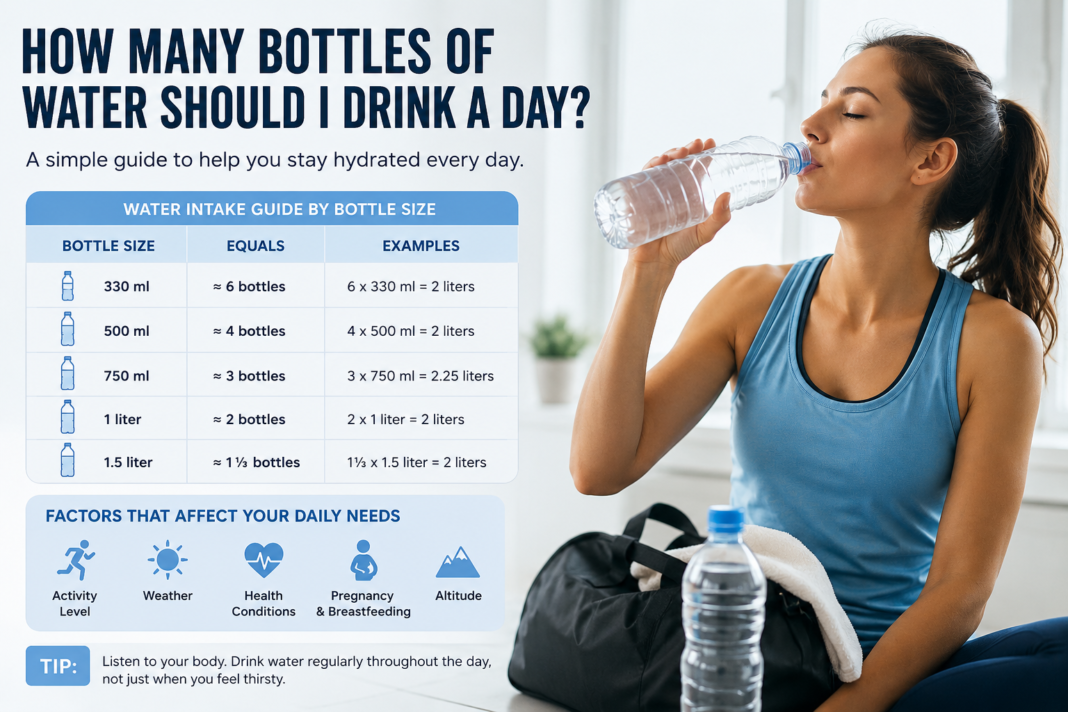

Wondering how many bottles of water should I drink a day? The answer depends on more than simply counting bottles. Your bottle size, activity level, climate, health, age, and other factors can all affect how much fluid you need.
A useful starting point is to understand the difference between total fluid intake and plain water. Water from beverages and food contributes to your daily total, so a recommendation for total water intake does not necessarily mean you need to drink that exact amount from water bottles alone. The National Academies, for example, lists adequate intake levels for total water of about 3.7 liters per day for adult men and 2.7 liters for adult women, including water from food and beverages.
The easiest way to make the numbers practical is to consider your bottle size. Four 500 mL bottles, for example, contain 2 liters of water.
How Many Bottles of Water Should You Drink a Day?
There is no single bottle count that is right for everyone.
Your daily fluid needs can change depending on how active you are, the weather, where you live, your health, and other personal circumstances. Mayo Clinic also emphasizes that there is no simple one-size-fits-all answer to daily water intake.
Bottle size matters, too. Saying “I drink four bottles a day” doesn’t tell you very much unless you know how large those bottles are.
For example:
- Four 330 mL bottles = 1.32 liters
- Four 500 mL bottles = 2 liters
- Four 750 mL bottles = 3 liters
- Four 1-liter bottles = 4 liters
That is why it is better to think about liters or milliliters first and bottle count second.
A simple bottle calculation
You can convert a daily water amount into bottles using this formula:
Number of bottles = daily water volume ÷ bottle volume
For example, if you want to convert 2 liters into 500 mL bottles:
2,000 mL ÷ 500 mL = 4 bottles
This is a mathematical conversion, not a recommendation that everyone needs exactly 2 liters of plain water.
How Many Bottles Equal 2 Liters of Water?
Two liters is a common reference point, so it helps to know how it translates into different bottle sizes.
| Bottle size | Bottles needed for 2 liters |
| 330 mL | About 6 |
| 500 mL | 4 |
| 750 mL | About 2.7 |
| 1 liter | 2 |
| 1.5 liters | About 1.3 |
If your bottle has volume markings, use those markings rather than guessing.
For example, someone using a 750 mL reusable bottle would need roughly three full bottles to reach 2.25 liters. Someone using a 500 mL bottle would need four bottles to reach 2 liters.
Again, these figures simply show how much water is in a certain number of bottles. They should not be interpreted as a universal daily prescription.
How Many 500 mL Bottles of Water Should You Drink?
A 500 mL bottle contains half a liter of water, making conversions particularly easy.
| Water volume | 500 mL bottles |
| 1 liter | 2 bottles |
| 1.5 liters | 3 bottles |
| 2 liters | 4 bottles |
| 2.5 liters | 5 bottles |
| 3 liters | 6 bottles |
If you use a 500 mL bottle, you can also track your intake by counting refills.
For example, instead of thinking about drinking six separate bottles, you could think of it as six 500 mL bottle-equivalents over the course of the day.
The important question is whether that volume is appropriate for your circumstances. Your needs may be different on a hot day, during prolonged exercise, or when you are sick.
How Many 1-Liter Bottles Should You Drink?
One-liter bottles are popular because they make tracking fluids simple.
The conversions are straightforward:
- 1 liter = 1 bottle
- 2 liters = 2 bottles
- 2.5 liters = 2.5 bottles
- 3 liters = 3 bottles
- 4 liters = 4 bottles
A large reusable bottle can make hydration tracking easier because you only need to remember how many times you have emptied and refilled it.
However, avoid assuming that a particular number of refills is automatically healthy for everyone. Hydration needs are individual, and total water includes fluid from foods and other beverages.
How Much Water Do Adults Actually Need?
One reason water-intake advice can seem confusing is that different recommendations use different measurements.
The National Academies’ adequate intake for total water is 3.7 liters per day for adult men and 2.7 liters per day for adult women. These figures include water from drinking water, other beverages, and food.
That distinction is important.
It does not mean every adult man needs to drink 3.7 liters of plain bottled water every day, or that every woman needs exactly 2.7 liters from water bottles.
Your actual needs can vary. Mayo Clinic notes that factors such as age, health, physical activity, location, and weather influence how much water a person needs.
Think of these numbers as useful reference points rather than rigid bottle targets.
What Counts Toward Your Daily Fluid Intake?
Water isn’t the only source of fluid.
Plain water
Water is an easy way to stay hydrated without adding calories or sugar.
Tea and coffee
Beverages such as tea and coffee also contain water and can contribute to overall fluid intake. However, that doesn’t mean every beverage is nutritionally equivalent to plain water.
Milk and other beverages
Milk and other drinks also provide fluid. Consider their overall nutritional content when deciding what you drink regularly.
Water-rich foods
Many foods contain significant amounts of water. Fruits, vegetables, soups, and similar foods can contribute to total water intake.
The National Academies notes that food contributed roughly 19% of total water intake in the U.S. data used to establish its adult adequate-intake figures.
This is why focusing exclusively on the number of water bottles can give an incomplete picture.
Do You Need More Water When You Exercise?
Exercise can increase fluid losses because you lose water through sweat.
A short, easy workout in a cool environment is very different from several hours of strenuous activity outdoors in hot, humid weather.
If you exercise regularly, pay attention to:
- How much you sweat
- How long you exercise
- The temperature and humidity
- Your thirst
- How you feel before and after exercise
During prolonged or intense exercise, hydration planning may require more than simply carrying a standard bottle of water.
The goal isn’t to force down a specific number of bottles. Instead, replace fluids appropriately and adjust for the conditions.
When You May Need More Water
Your usual fluid intake may not be enough in every situation.
Hot or humid weather
Heat can increase sweating and fluid losses. You may need to pay closer attention to fluids when spending significant time outdoors.
Exercise and heavy sweating
Long or intense physical activity can increase your water requirements.
Illness
Fever, vomiting, and diarrhea can contribute to fluid loss. Significant fluid loss may require medical advice rather than simply drinking more bottled water.
High altitude
Changes in environment and activity at higher elevations can affect hydration needs.
Pregnancy and breastfeeding
Fluid requirements can change during pregnancy and breastfeeding, so individual guidance may be appropriate.
Mayo Clinic specifically identifies factors such as exercise, hot environments, illness, pregnancy, breastfeeding, and altitude as circumstances that can affect fluid needs.
How Do You Know If You’re Drinking Enough Water?
There is no perfect bottle number that can tell you whether you are adequately hydrated.
Instead, consider several signals.
Pay attention to thirst
Thirst is one useful signal that your body needs fluid. However, circumstances such as strenuous exercise, illness, or extreme heat may require additional attention to hydration.
Check your urine
Urine color can provide a practical clue. Generally, pale-yellow urine is often associated with adequate hydration, while darker urine can occur when you are more concentrated.
Urine color alone, however, should not be treated as a medical diagnosis.
Notice dehydration symptoms
Possible signs of dehydration include:
- Dry mouth
- Dark urine
- Dizziness
- Fatigue
- Headache
- Reduced urination
Severe symptoms or significant fluid loss should be evaluated by a healthcare professional.
Can You Drink Too Much Water?
Yes. More water is not automatically better.
Drinking excessive amounts of water can dilute the sodium concentration in your blood, potentially causing hyponatremia. This is one reason you should not force yourself to drink an arbitrary number of bottles simply because you believe more water must be healthier.
The National Academies notes that total water includes food and beverages and that there is no established tolerable upper intake level for total water; it also notes that the body’s capacity to excrete excess water has limits.
The practical lesson is simple: drink enough to meet your body’s needs rather than trying to maximize your water intake.
Is 4 Bottles of Water a Day Enough?
It depends on the bottle size and your individual needs.
Four 330 mL bottles provide only 1.32 liters.
Four 500 mL bottles provide 2 liters.
Four 750 mL bottles provide 3 liters.
Four 1-liter bottles provide 4 liters.
So if someone says they drink “four bottles a day,” you need to know the bottle capacity before judging whether that amount is low, adequate, or excessive.
Is 8 Bottles of Water a Day Too Much?
Again, bottle size makes a major difference.
Eight 330 mL bottles equal about 2.64 liters.
Eight 500 mL bottles equal 4 liters.
Eight 750 mL bottles equal 6 liters.
Those are very different amounts.
The popular idea of drinking “eight glasses a day” should not automatically be converted into “eight bottles.” Glasses and bottles come in different sizes, and individual hydration requirements vary.
Drinking large quantities rapidly can also be unsafe. The goal should be appropriate hydration rather than hitting an arbitrary number.
How to Calculate Your Daily Bottle Goal
If you already know the approximate amount of water you want to convert into bottles, the calculation is easy.
Daily bottle count = water volume ÷ bottle capacity
For example:
Target: 2.5 liters
Bottle: 500 mL
Convert 2.5 liters to 2,500 mL:
2,500 ÷ 500 = 5 bottles
For a 750 mL bottle:
2,500 ÷ 750 = about 3.3 bottles
This calculation can help you track your intake, but it shouldn’t replace individualized medical advice.
Easy Ways to Stay Hydrated
You don’t need to obsessively count every sip.
Try these practical habits:
- Carry a reusable bottle.
- Keep water available at your desk or workspace.
- Drink with meals.
- Refill your bottle at predictable times.
- Choose a bottle with volume markings.
- Pay more attention to hydration during heat and exercise.
- Include water-rich fruits and vegetables in your diet.
- Avoid forcing yourself to drink excessive amounts just to meet a predetermined number.
A simple routine can be more sustainable than trying to drink several bottles at once.
Common Water-Drinking Mistakes
Counting bottles without checking their size
A bottle count means little without knowing its volume.
Treating eight bottles as a universal rule
There is no single bottle number that applies to every person.
Forgetting other sources of fluid
Food and other beverages contribute to total water intake.
Ignoring exercise and weather
Heat, humidity, and physical activity can increase fluid losses.
Drinking huge amounts at once
Spreading fluid intake throughout the day is generally more sensible than rapidly consuming a large volume.
Assuming more is always healthier
Excessive water intake can create health risks, so hydration should be balanced rather than excessive.
Conclusion
So, how many bottles of water should I drink a day? There isn’t one correct number for everyone.
The first thing to check is your bottle size. Four 500 mL bottles equal 2 liters, while four 1-liter bottles equal 4 liters. After that, consider your overall fluid intake, including water from food and other beverages.
Your hydration needs can also change with exercise, hot weather, illness, pregnancy, breastfeeding, and other factors. Instead of following an arbitrary bottle target, use bottle measurements as a practical tracking tool and pay attention to your body’s needs.
Most importantly, more water isn’t always better. Good hydration means getting an appropriate amount of fluid—not simply drinking as many bottles as possible.
Frequently Asked Questions
1. How many bottles of water should I drink a day?
There is no universal number because bottle sizes and individual fluid needs vary. Four 500 mL bottles contain 2 liters, but your appropriate intake may be higher or lower depending on activity, weather, health, and other factors.
2. How many 500 mL bottles of water should I drink a day?
The number depends on your overall fluid needs. For conversion purposes, two 500 mL bottles equal 1 liter, four equal 2 liters, and six equal 3 liters. These are volume conversions rather than universal medical recommendations.
3. How many bottles of water is 2 liters?
Two liters equals approximately six 330 mL bottles, four 500 mL bottles, 2.7 750 mL bottles, or two 1-liter bottles.
4. Is four bottles of water a day enough?
It depends on the bottle size. Four 500 mL bottles provide 2 liters, while four 330 mL bottles provide only 1.32 liters. Your activity level, climate, health, and other sources of fluid also matter.
5. Is eight bottles of water a day too much?
It depends on bottle size and individual circumstances. Eight 500 mL bottles equal 4 liters, which is very different from eight 330 mL bottles. Drinking excessive water, particularly quickly, can be harmful.
6. Does coffee count toward daily fluid intake?
Coffee contains water and can contribute to overall fluid intake. However, plain water remains a simple choice for hydration, and beverages should also be considered based on their sugar, calorie, and caffeine content.
7. How can I tell if I’m drinking enough water?
Thirst, urine color, urination patterns, and symptoms such as dizziness or unusual fatigue can provide useful clues. Your needs can change with exercise, heat, illness, and other circumstances.