
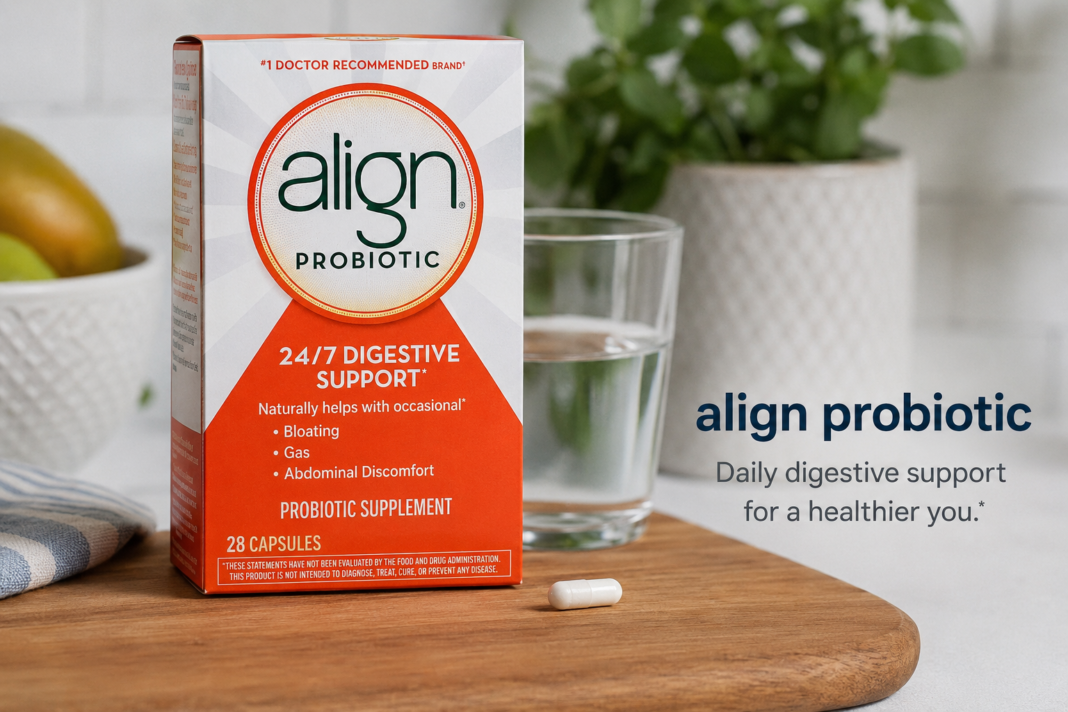

If you’re searching for an align probiotic, you probably want to know more than whether it contains “good bacteria.” You may be wondering whether Align actually works, what benefits it offers, whether it can help with bloating or IBS symptoms, how to take it, and whether side effects are possible.
Align is a daily probiotic dietary supplement centered on a specific strain called Bifidobacterium 35624™. The company describes this strain as its distinctive probiotic ingredient and positions the product for digestive health and occasional bloating, gas, and abdominal discomfort.
However, choosing a probiotic isn’t simply about picking the product with the most bacteria or the longest ingredient list. Strain identity, research, formulation, storage, and your individual health needs all matter.
What Is Align Probiotic?
Align is a probiotic dietary supplement designed to support digestive health. Unlike a medication, it is not intended to diagnose, treat, or cure a disease. The manufacturer recommends one capsule daily for its 24/7 Digestive Support product.
The product’s key feature is Bifidobacterium 35624™, a specific probiotic strain that has been studied for digestive health. The strain has also been referred to by earlier names, including Bifidobacterium infantis 35624; Align’s current educational material identifies it as Bifidobacterium longum 35624™.
This distinction is important because two probiotics can both contain Bifidobacterium while having completely different strains and research behind them.
Why does the strain matter?
Think of the strain as the probiotic’s individual identity. The genus and species tell you what type of microorganism it is, while the strain identifies the specific organism being studied.
That means evidence for one probiotic strain shouldn’t automatically be applied to every supplement containing the same bacterial species.
Align Probiotic Ingredients at a Glance
The current Align 24/7 Digestive Support product contains the Bifidobacterium 35624™ strain. The manufacturer states that each capsule contains at least 1 billion live bacteria when manufactured, with a guaranteed effective level through the product’s best-by date.
| Feature | Align Probiotic |
| Main probiotic strain | Bifidobacterium 35624™ |
| Format | Capsule |
| Suggested use | One capsule daily |
| Refrigeration | Not required |
| Gluten | Gluten-free |
| Storage | Original bottle at room temperature |
| Main focus | Digestive health |
Product formulations can change, so always check the current package and Supplement Facts panel before using a specific Align product.
How Does Align Probiotic Work?
The basic idea behind probiotics is that they introduce live microorganisms that may provide a health benefit when consumed. Probiotics can interact with the complex microbial environment in the gastrointestinal tract, although their effects vary depending on the microorganism, formulation, and individual.
Align focuses on a single, specifically identified strain rather than relying on a large mixture of unrelated strains.
Is a higher CFU automatically better?
No.
CFU, or colony-forming units, tells you about the number of viable microorganisms. It doesn’t tell you whether one probiotic is automatically better than another.
When comparing products, consider:
- The exact strain
- The clinical evidence for that strain
- The intended health goal
- The dose used in research
- Product stability and storage
- Other ingredients
This is one reason comparing probiotics solely by their “billions of bacteria” can be misleading.
Align Probiotic Benefits
The potential benefits of an align probiotic should be considered in the context of the specific strain and the evidence available rather than probiotics as a whole.
Digestive health support
Align is primarily positioned as a daily supplement for digestive health. The manufacturer says its Bifidobacterium 35624™ strain helps support digestive balance and digestive wellness.
For someone looking for everyday digestive support, the product may be an option to discuss with a healthcare professional, particularly if the goal is to use a specific, researched strain rather than a multi-strain formula.
Bloating, gas, and abdominal discomfort
Align specifically markets its 35624™ strain for occasional bloating, gas, and abdominal discomfort.
However, digestive symptoms have many possible causes. Persistent bloating, significant abdominal pain, unexplained weight loss, blood in the stool, or ongoing changes in bowel habits should not simply be treated as a probiotic problem.
Align and IBS
Probiotics have been studied in people with irritable bowel syndrome, but the evidence is mixed. A review discussed by the National Center for Complementary and Integrative Health found that some probiotics may improve symptoms such as abdominal pain, bloating, and gas, but differences between products and study designs make it difficult to identify one universally effective probiotic.
Therefore, it is more accurate to say that Align may be worth considering for someone researching probiotic options for digestive symptoms than to claim that it will treat IBS for everyone.
Does Align Probiotic Actually Work?
The most useful way to evaluate Align is to separate clinical evidence, manufacturer information, and customer experience.
Clinical research can help determine whether a particular strain has shown a measurable effect under controlled conditions. Product information tells you what is actually in the supplement and how it is intended to be used. Consumer reviews can describe personal experiences but cannot establish that a product works for everyone.
The broader probiotic research supports this cautious approach: probiotic effects can differ significantly between strains and individuals.
In other words, a probiotic doesn’t need to work for every person to have evidence supporting a particular use—but consumers should also avoid assuming that one positive study guarantees the same result for them.
Align Probiotic Side Effects
Most healthy people tolerate probiotics reasonably well, but side effects can occur. Possible digestive reactions include gas, bloating, abdominal discomfort, cramping, or changes in bowel habits. The available safety evidence for probiotics is also less extensive than many consumers may assume.
Can Align cause gas or bloating?
It can. Some people may notice digestive changes after beginning a probiotic.
If symptoms are mild, monitoring how your body responds may be reasonable. But severe, persistent, or unusual symptoms deserve medical attention rather than simply increasing or continuing a supplement.
Who should be especially cautious?
The risk of serious complications from probiotics can be greater for people who are severely ill or have compromised immune systems. Align specifically advises people who are severely ill or immunocompromised to consult a healthcare professional before use.
Pregnant or breastfeeding individuals should also ask a healthcare professional before taking Align, according to the manufacturer’s current guidance.
How to Take Align Probiotic
For the Align 24/7 Digestive Support product, the manufacturer recommends one capsule daily. It can be taken with or without food and with or without water. Consistency is emphasized because probiotic use is intended to be part of a daily routine.
Storage is also straightforward. Align does not require refrigeration and should be kept in its original bottle at room temperature to help protect the probiotic through its best-by date.
Always follow the instructions on the specific product you purchased because formulations can differ.
How Long Does Align Probiotic Take to Work?
There isn’t a universal timeline that guarantees when someone will notice a benefit.
Your response can depend on the reason you’re taking the probiotic, your existing digestive health, diet, gut microbiome, and individual sensitivity.
A practical approach is to:
- Follow the product directions consistently.
- Pay attention to meaningful changes in your symptoms.
- Avoid assuming that more capsules will produce faster results.
- Reassess if symptoms persist or become worse.
If you’re using a probiotic for ongoing gastrointestinal symptoms, don’t let the supplement delay appropriate medical evaluation.
Align Probiotic and Antibiotics
Probiotics are sometimes used alongside antibiotics because antibiotic treatment can affect the microorganisms in the digestive tract. Research has found that some probiotic preparations may reduce the risk of antibiotic-associated diarrhea, although the evidence varies by probiotic and patient group.
That doesn’t mean every probiotic should automatically be taken with every antibiotic.
If you’re taking prescription medication, ask your doctor or pharmacist whether an align probiotic is appropriate and how to schedule it with your medication.
Who Is Align Probiotic Best Suited For?
Align may be worth researching for a healthy adult who wants a daily probiotic focused on digestive health and prefers a product built around a specific strain.
For example, someone who frequently experiences occasional bloating may want to compare Align with other probiotic options and evaluate the evidence behind each strain.
Someone with persistent abdominal pain or unexplained digestive changes, however, should focus first on finding the underlying cause rather than relying on a supplement alone.
Align Probiotic Reviews: What Are Users Saying?
Consumer reviews can be useful for understanding real-world experiences, but they should be treated as anecdotal evidence.
Some users may report improvements in digestive comfort, regularity, gas, or bloating. Others may report little noticeable benefit or temporary digestive discomfort.
The important point is that reviews show individual experiences—not guaranteed outcomes.
When reading Align probiotic reviews, look for recurring patterns rather than relying on one extremely positive or negative testimonial.
Align Probiotic Pros and Cons
| Pros | Cons |
| Uses a specifically identified probiotic strain | Individual results can vary |
| Designed for daily digestive support | May cause temporary digestive symptoms |
| Does not require refrigeration | Not suitable for everyone without medical advice |
| Convenient one-capsule daily routine | Can be more expensive than some alternatives |
| Strain has been clinically studied | Evidence for probiotics isn’t universal across all conditions |
Align Probiotic vs Other Probiotics
The “best” probiotic depends on the specific goal.
When comparing Align with another product, don’t simply compare the number of strains or CFUs. Look at whether the specific strain has research relevant to your goal, what dose was studied, the formulation, storage requirements, and additional ingredients.
For example, someone interested in IBS-related symptoms may prioritize research involving a relevant strain, while another person may have a completely different reason for choosing a probiotic.
Is Align Probiotic Worth It?
Align can be a reasonable option for people specifically interested in a researched probiotic strain for digestive support, but it isn’t automatically the right probiotic for everyone.
Its biggest advantage is its focus on a clearly identified strain and convenient daily use. Its biggest limitation is the same limitation shared by probiotics generally: individual responses vary, and evidence for one strain shouldn’t be generalized to every digestive condition.
If you’re considering Align, focus on your health goal, the evidence behind the strain, product ingredients, cost, and safety considerations rather than choosing based only on popularity or CFU count.
Conclusion
Align is a well-known probiotic supplement built around the specific Bifidobacterium 35624™ strain and designed to support digestive health. Its targeted formulation, convenient daily use, and research surrounding the strain make it an option worth investigating for people interested in probiotic support.
Still, probiotics aren’t one-size-fits-all. Side effects can occur, research varies by strain and condition, and people with certain medical circumstances should seek professional advice before use. The smartest approach is to look beyond marketing claims and consider the specific strain, evidence, ingredients, safety, and your individual digestive-health goals.
Frequently Asked Questions
Is Align probiotic good for IBS?
Some probiotic strains have shown potential for improving IBS symptoms, but probiotic evidence is inconsistent across products. Align may be an option to discuss with a healthcare professional, but it shouldn’t be presented as a guaranteed IBS treatment.
What are the side effects of Align probiotic?
Possible digestive effects include gas, bloating, abdominal discomfort, cramping, or changes in bowel habits. People with serious health conditions or weakened immune systems should consult a healthcare professional before using probiotics.
Can you take Align every day?
Yes. The manufacturer specifically describes Align as a daily probiotic and recommends one capsule per day for its 24/7 Digestive Support product.
Does Align need to be refrigerated?
No. The manufacturer says Align does not require refrigeration and recommends storing it in its original bottle at room temperature.
Can you take Align with antibiotics?
Some probiotics have been studied alongside antibiotics, particularly for antibiotic-associated diarrhea, but the appropriate product and timing can vary. Ask a healthcare professional or pharmacist about your specific medication.
Does Align cause bloating?
Some people may experience gas or bloating when taking probiotics. If symptoms are severe, persistent, or concerning, seek medical advice rather than assuming the reaction is normal.
Is Align a medication?
No. Align is marketed as a dietary supplement rather than a drug or medicine.