
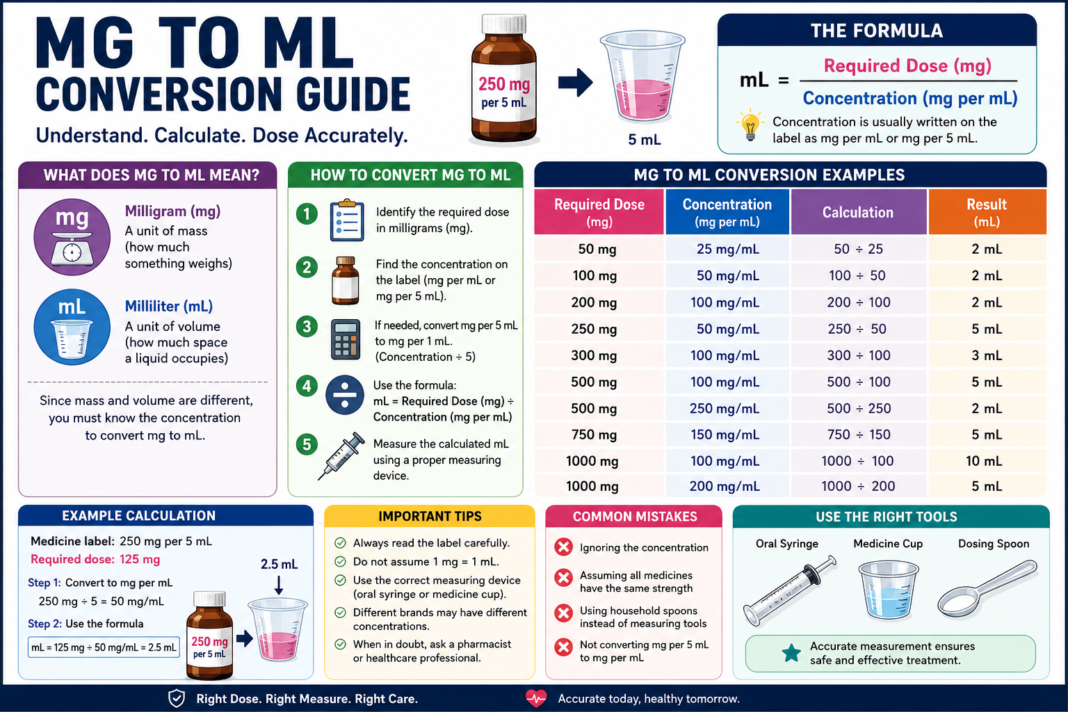

Converting mg to ml is one of the most common calculations people encounter when measuring medications, supplements, laboratory solutions, and liquid ingredients. While the conversion may seem straightforward, it is often misunderstood because milligrams measure weight, whereas milliliters measure volume. Without knowing the density or concentration of a substance, an accurate conversion is impossible.
Whether you’re reading a prescription label, preparing a nutritional supplement, or trying to understand dosage instructions, learning how mg to ml conversions work helps prevent mistakes and improves confidence. This comprehensive guide explains the science behind the conversion, practical formulas, real-life examples, and common misconceptions while introducing important dosage calculation and liquid medication concepts you’ll encounter in everyday situations.
What Does mg to ml Mean?
The phrase mg to ml refers to converting milligrams (mg), which measure mass, into milliliters (mL), which measure volume. Since these units represent different physical properties, the conversion always depends on the concentration or density of the substance involved. Understanding this difference is essential when working with measurement units and solution concentration.
Imagine pouring syrup and water into identical measuring cups. Both occupy the same volume, but the syrup weighs more because it is denser. This simple example demonstrates why the same number of milligrams may occupy different amounts of space depending on the liquid. Recognizing this relationship between density and volume measurement helps eliminate confusion during conversions.
Understanding Milligrams
A milligram is a metric unit of mass equal to one-thousandth of a gram. It is commonly used to measure very small quantities of substances such as medications, vitamins, minerals, and chemicals. Healthcare professionals rely on mass measurement and drug dosage values to prescribe accurate treatments for patients.
Many prescription labels display medicine strength in milligrams because this indicates the amount of active ingredient present. Whether a tablet contains 250 mg or a liquid contains 500 mg, the milligram value describes the substance’s weight rather than the amount of liquid it occupies. This distinction is fundamental when interpreting active ingredient and medication strength information.
Understanding Milliliters
A milliliter is a metric unit of volume that measures the amount of space occupied by a liquid. It equals one-thousandth of a liter and is commonly used for syrups, injections, beverages, and laboratory solutions. Accurate liquid measurement and volume conversion ensure consistency in both healthcare and scientific applications.
When a medicine bottle states “5 mL,” it describes how much liquid should be measured rather than how much medicine is inside. Two different medications can each require 5 mL while containing entirely different amounts of active ingredients because their concentrations vary. Understanding oral suspension and liquid dosage labels prevents incorrect assumptions.
Why You Cannot Convert mg to ml Directly
One of the biggest misconceptions is believing there is a universal formula for converting mg to ml. Unlike converting centimeters to meters or grams to kilograms, this conversion requires additional information because weight and volume measure different properties. The missing factor is the liquid’s concentration or specific gravity.
For example, 500 mg of one medication may equal 5 mL, while another medicine with the same weight may require only 2.5 mL because it is more concentrated. The conversion changes depending on the product’s formulation. That’s why healthcare providers emphasize checking the prescription label and dosage instructions before measuring any liquid medicine.
The Formula for mg to ml Conversion
The standard formula for converting mg to ml is:
Milliliters (mL) = Milligrams (mg) ÷ Concentration (mg per mL)
This equation works because the concentration tells you how many milligrams are present in each milliliter. Understanding mg per mL and concentration ratio allows you to solve dosage calculations accurately without relying on guesswork.
For example, if a medicine contains 100 mg per mL and you need 300 mg, dividing 300 by 100 gives 3 mL. The process becomes straightforward once the concentration is known. Mastering this calculation improves confidence when reading medicine labels and preparing accurate doses.
Why Concentration Matters
Concentration describes how much of a substance exists within a certain volume of liquid. It is usually written as mg/mL and serves as the bridge between mass and volume. Without knowing the concentration, no reliable mg to ml conversion can be performed. This is why understanding solution strength and pharmaceutical concentration is so important.
Consider two bottles of cough syrup that both contain 100 mL of liquid. One bottle may contain 50 mg/mL, while the other contains 100 mg/mL. Even though the bottles are the same size, the amount of medicine in each milliliter differs significantly. Paying attention to medicine concentration and dosage accuracy helps avoid potentially serious errors.
Common Examples of mg to ml Conversion
Real-world examples make the mg to ml concept easier to understand. If a liquid medication has a concentration of 250 mg per 5 mL, each milliliter contains 50 mg. A prescribed dose of 100 mg would therefore require 2 mL of the liquid. This demonstrates the importance of identifying the concentration formula and dose calculation before measuring.
Similarly, a vitamin supplement labeled 1000 mg per 10 mL provides 100 mg in every milliliter. Someone needing 500 mg would take 5 mL rather than estimating the amount visually. Using proper measuring devices and understanding supplement dosage improves both safety and consistency.
Where mg to ml Conversions Are Used
Healthcare professionals perform mg to ml calculations daily when preparing oral medicines, injectable drugs, intravenous fluids, and pediatric prescriptions. Pharmacists, nurses, and physicians rely on precise clinical dosing and medical calculations to ensure patients receive the intended amount of medication.
Beyond healthcare, these conversions appear in nutritional supplements, cosmetic formulations, laboratory research, veterinary medicine, and food manufacturing. Whether mixing chemicals in a lab or preparing liquid vitamins at home, understanding formulation accuracy and measurement precision supports reliable results and minimizes mistakes.
Common mg to ml Conversion Table
Although there is no universal mg to ml conversion, the following table demonstrates how different concentrations produce different volumes. It highlights why knowing the solution concentration and dosage strength is essential before making any calculation.
| Required Dose (mg) | Concentration | Result (mL) | Practical Example |
| 50 mg | 25 mg/mL | 2 mL | Mild liquid medication |
| 100 mg | 50 mg/mL | 2 mL | Children’s syrup |
| 200 mg | 100 mg/mL | 2 mL | Prescription solution |
| 250 mg | 50 mg/mL | 5 mL | Oral suspension |
| 300 mg | 100 mg/mL | 3 mL | Vitamin supplement |
| 500 mg | 100 mg/mL | 5 mL | Liquid antibiotic |
| 500 mg | 250 mg/mL | 2 mL | Concentrated medicine |
| 750 mg | 150 mg/mL | 5 mL | Medical preparation |
| 1000 mg | 100 mg/mL | 10 mL | Nutritional liquid |
| 1000 mg | 200 mg/mL | 5 mL | High-strength formulation |
This table shows that identical milligram values can produce completely different milliliter measurements depending on the product. Always verify the medicine label and mg per mL information instead of assuming every liquid follows the same ratio.
Step-by-Step Guide to Convert mg to ml
Learning the correct process makes every mg to ml calculation easier and more reliable. Begin by identifying the required dose in milligrams and then locate the concentration shown on the product label. Most medications clearly display this information as mg per mL or mg per 5 mL. Understanding label reading and dosage information prevents unnecessary confusion.
Next, divide the required milligrams by the concentration expressed in milligrams per milliliter. If the label lists the concentration per 5 mL, convert it to a per-milliliter value before calculating. Using this systematic approach along with calculation accuracy and measurement consistency greatly reduces the risk of dosing mistakes.
Examples of Everyday mg to ml Calculations
Suppose a doctor prescribes 400 mg of a medicine that contains 80 mg per milliliter. Dividing 400 by 80 gives 5 mL, meaning the patient should measure five milliliters of the liquid. This straightforward example demonstrates how prescription dosage and liquid concentration work together.
Another example involves a nutritional supplement containing 500 mg in every 10 mL. First, determine that each milliliter contains 50 mg. A serving of 250 mg would therefore require 5 mL. Applying serving size and supplement concentration concepts makes the calculation simple and repeatable.
Understanding Labels That Say mg per 5 mL
Many liquid medications are labeled as milligrams per 5 mL instead of per milliliter because 5 mL equals one standard teaspoon. This format is especially common for children’s medicines and oral suspensions. Recognizing medicine labeling and teaspoon equivalent measurements helps users interpret instructions correctly.
For example, if a bottle states 250 mg per 5 mL, dividing 250 by 5 shows that each milliliter contains 50 mg. Once converted into mg per mL, calculating any required dose becomes much easier. Familiarity with label conversion and dose measurement improves confidence when administering medication.
Common Mistakes People Make
A frequent error is assuming that one milligram always equals one milliliter. This misunderstanding ignores the role of concentration and can result in measuring far too much or too little liquid. Appreciating the difference between mass versus volume and conversion accuracy is essential for safe use.
Another common mistake involves overlooking changes in concentration between different brands or formulations of the same medicine. Two products with identical names may contain different strengths, making direct comparisons misleading. Always verify the product formulation and strength variation before calculating a dose.
Why Density Can Affect Conversion
While medication labels typically provide concentration directly, density becomes important when converting substances that are not standard pharmaceutical solutions. Thick syrups, oils, industrial chemicals, and laboratory liquids may occupy different volumes even when they share the same weight. This relationship between density measurement and physical properties explains why conversions vary.
For example, one gram of water occupies approximately one milliliter under normal conditions, but oils and syrups often have different densities. Therefore, using water-based assumptions for every substance can produce inaccurate results. Understanding specific density and material composition leads to more reliable conversions.
“In measurement, accuracy is not just about getting the right number—it is about understanding what that number truly represents.”
Using mg to ml in Healthcare
Healthcare professionals perform mg to ml calculations countless times every day when preparing prescriptions, intravenous medications, vaccinations, and pediatric treatments. Even small calculation errors can affect treatment outcomes, which is why clinical accuracy and patient safety remain top priorities.
Modern hospitals often use electronic calculators and digital prescribing systems to reduce human error, but medical professionals still learn manual conversion methods. A solid understanding of pharmaceutical calculations and dosage verification provides an additional layer of protection whenever medications are administered.
Why Parents Should Understand mg to ml
Parents frequently encounter mg to ml conversions when giving fever reducers, antibiotics, allergy medicines, or vitamin supplements to children. Since pediatric doses are often based on age or body weight, understanding child dosage and medicine administration helps ensure the correct amount is given.
Rather than estimating with household spoons, parents should always use the measuring syringe or medicine cup included with the product. These tools provide greater precision while supporting accurate measurement and safe dosing, reducing the chance of accidental underdosing or overdosing.
Conclusion
Understanding mg to ml is about much more than memorizing a formula. Since milligrams measure mass and milliliters measure volume, every conversion depends on the concentration or density of the substance involved. Recognizing the relationship between measurement accuracy and solution concentration helps eliminate guesswork and improves confidence when handling medications, supplements, or laboratory solutions.
Whether you’re a patient, parent, healthcare professional, student, or researcher, taking a few extra moments to verify the concentration before converting can prevent costly mistakes. By mastering the formula, reading labels carefully, and using proper measuring tools, you’ll be able to perform mg to ml calculations accurately and safely in virtually any real-world situation while maintaining dosage precision and medication safety.
Frequently Asked Questions
Can I convert mg to ml without knowing the concentration?
No. A mg to ml conversion cannot be performed accurately unless you know the product’s concentration or density. Understanding mg per mL and solution strength is essential because weight and volume are different units of measurement.
Is 1 mg equal to 1 mL?
Not necessarily. Whether 1 mg equals 1 mL depends entirely on the liquid’s concentration. Learning the difference between mass measurement and volume measurement helps avoid one of the most common conversion mistakes.
Why do medicine bottles list mg per 5 mL instead of mg per mL?
Many liquid medications use a 5 mL serving because it matches a standard medicine teaspoon. Converting that value into mg per mL using label interpretation makes future mg to ml calculations much easier.
Are mg to ml conversions the same for every medicine?
No. Every medication has its own concentration, so mg to ml results vary from one product to another. Checking the medicine concentration and prescription label before measuring is always the safest approach.
What tools should I use to measure liquid medicine?
Use an oral syringe, medicine cup, or calibrated dosing spoon instead of household utensils. These devices improve dose accuracy and measurement precision, making every mg to ml calculation more reliable.
Does density matter when converting mg to ml?
Yes. Density becomes especially important when a product’s concentration is not already provided. Understanding specific gravity and liquid density helps explain why substances with the same weight can occupy different volumes.
Can online calculators replace manual calculations?
Online calculators can be useful, but they are only as accurate as the information entered. Always verify the concentration value and dosage instructions before relying on a digital mg to ml conversion.
Is mg to ml used outside healthcare?
Absolutely. mg to ml conversions are also used in scientific research, chemistry, cosmetics, veterinary medicine, food production, and nutritional supplements. Knowledge of laboratory measurement and formulation science is valuable across many industries.
You May Also Read : Neuro Gum