
When it comes to English spelling confusion, few word pairs create as much uncertainty as Dieing vs Dying. This mix-up appears frequently in writing, search queries, and even professional communication, often leading to grammatical errors that reduce clarity and credibility.
In this comprehensive guide, we will break down everything you need to know about Dieing vs Dying, including meaning, grammar rules, common mistakes, and practical examples. By the end, you’ll confidently understand why one form is correct and how to avoid one of the most frequent spelling errors in English.
Understanding Dieing vs Dying: What Do These Words Mean?
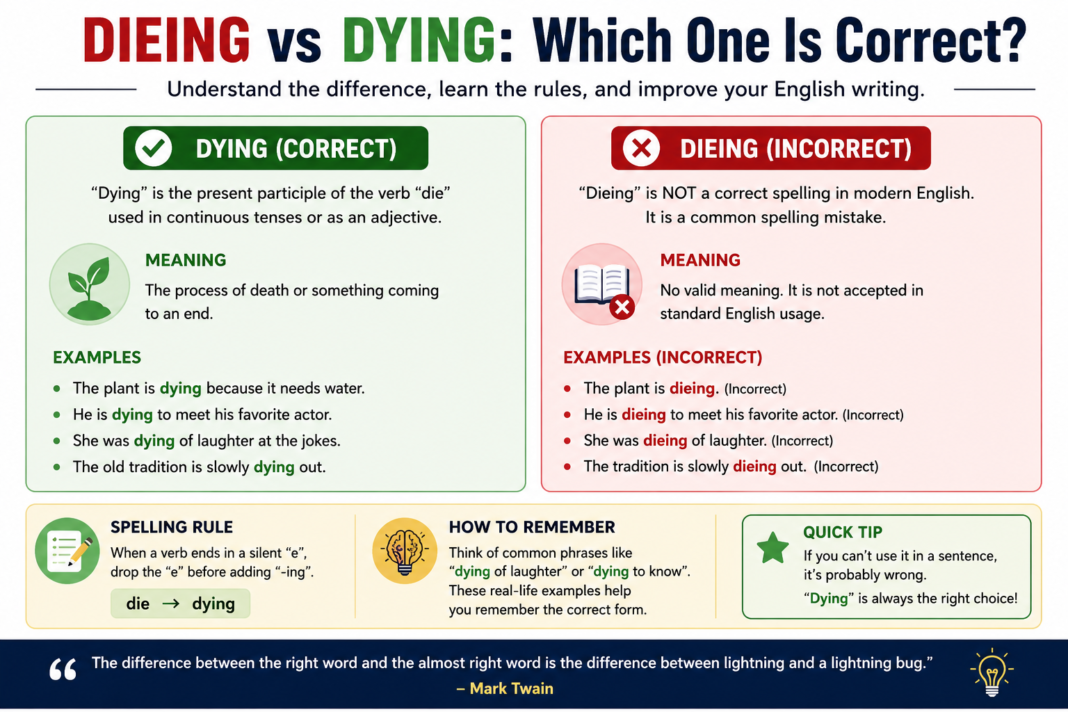
The confusion between Dieing vs Dying often starts with misunderstanding how English verbs change in different forms. While “dying” is a correct and widely used word, “dieing” is generally incorrect in modern usage.
This issue is closely tied to common misspelling patterns and broader grammar error challenges that learners face when dealing with irregular verbs in English.
The correct term “dying” refers to the process of death or something coming to an end. It is the present participle of the verb “die,” used in continuous tenses.
The incorrect form “dieing” often appears due to confusion about spelling rules, but it is not accepted in standard English usage.
This distinction is the foundation of understanding Dieing vs Dying, especially for learners aiming for accurate writing.
Why People Confuse Dieing vs Dying
The confusion around Dieing vs Dying is surprisingly common, even among native speakers. One major reason is the influence of English language confusion combined with inconsistent exposure to grammar rules in informal writing.
Another factor is the tendency to assume spelling follows simple patterns, leading to frequent spelling mistake issues when dealing with irregular verb forms like “die.”
Many learners also rely on pronunciation rather than spelling structure, which contributes to incorrect assumptions about how words should be written.
This misunderstanding becomes more noticeable in digital communication, where quick typing increases the chances of errors.
Ultimately, the confusion reflects a broader challenge in mastering English spelling conventions.
Correct Spelling Rules Behind Dying
The correct form “dying” follows standard English grammar rules for forming present participles. When verbs end in a silent “e,” the “e” is typically dropped before adding “-ing.”
This rule is essential in understanding verb form die transformations and how they behave in continuous tense structures.
In this case, “die” becomes “dying,” not “dieing,” because the final “e” is removed before adding the suffix.
This aligns with established present participle usage guidelines in English grammar.
Understanding this rule helps eliminate confusion and ensures proper usage in both formal and informal writing.
Meaning and Usage of Dying in English
The word “dying” carries multiple meanings depending on context, from literal death to metaphorical endings. It can refer to a living organism nearing death or something gradually fading away.
This usage is deeply connected to dictionary definition interpretations and broader language understanding frameworks.
In everyday communication, “dying” can also describe emotional or exaggerated states, such as “dying of laughter,” which shows its flexibility in English.
Grammatically, it is used in continuous tenses like “is dying,” “was dying,” or “has been dying.”
This versatility makes understanding word usage rules essential for accurate communication.
Common Mistakes People Make with Dieing vs Dying
One of the most frequent errors in writing is using “dieing” instead of “dying,” especially in informal contexts. This mistake often stems from poor understanding of verb patterns.
These errors are linked to writing accuracy problems and inconsistent application of grammar rules.
Another common issue is overgeneralization, where learners apply “-ing” rules without considering irregular verbs.
Such mistakes can significantly impact readability and professionalism in written content.
Improving awareness of these patterns is key to reducing content quality issues in writing.
Examples of Dieing vs Dying in Sentences
To better understand Dieing vs Dying, real-world examples are extremely helpful. Correct usage includes sentences like “The plant is dying بسبب lack of water” or “He is dying to meet her.”
These examples highlight proper learning English practices and reinforce correct grammatical structures.
Incorrect usage would be “The plant is dieing,” which is grammatically unacceptable in standard English.
Observing these differences helps improve language skills and builds stronger writing intuition.
With practice, recognizing the correct form becomes automatic in both speech and writing.
Comparison Table: Dieing vs Dying Explained Clearly
Below is a structured breakdown to highlight the differences between the two forms.
| Feature | Dying | Dieing |
| Correctness | Correct | Incorrect in modern English |
| Grammar Type | Present participle of “die” | Incorrect formation |
| Usage | Continuous tense, idioms, expressions | Not standard usage |
| Meaning | Dying or ending process | No accepted meaning |
| Acceptance | Widely accepted in English | Considered a spelling error |
This comparison reinforces the importance of recognizing homophone confusion and avoiding structural errors in writing.
Understanding these distinctions helps improve clarity and reduces long-term grammar issues in both academic and professional contexts.
How to Remember the Correct Form Easily
One simple way to remember Dieing vs Dying is to focus on the rule of dropping the final “e” before adding “-ing.” This mental shortcut helps eliminate confusion quickly.
This technique improves awareness of phonetics misunderstanding and strengthens spelling accuracy over time.
Another helpful method is associating “dying” with everyday phrases like “dying of hunger” or “dying to know,” which reinforces correct usage.
Frequent exposure to correct examples also reduces reliance on incorrect patterns.
Over time, these strategies improve natural recall and reduce spelling hesitation.
Importance of Correct Usage in Writing and SEO
Using the correct form in Dieing vs Dying is not just a grammar issue—it directly affects credibility in writing and digital content.
Incorrect spelling can harm SEO optimization efforts, as search engines prioritize accurate and relevant keyword usage.
Maintaining proper keyword intent ensures that content is interpreted correctly by both users and algorithms.
Even small spelling mistakes can reduce trust and engagement in professional writing.
Therefore, accuracy is essential for maintaining strong online visibility and authority.
Why Correct Spelling Matters in Communication
Clear writing is essential for effective communication, and mistakes like Dieing vs Dying can create unnecessary confusion.
Poor spelling often leads to reduced communication clarity and can affect how professional a message appears.
In business and academic environments, such errors may impact credibility and attention to detail perception.
Strong writing habits contribute to better understanding and smoother information exchange.
Ultimately, precision in language reflects overall professionalism and competence.
Common Myths and Misconceptions About Dieing vs Dying
A common myth is that “dieing” is an alternative or older spelling of “dying,” but this is not supported by modern English usage.
This misconception often comes from misunderstanding editing mistakes and outdated informal writing patterns.
Another belief is that both forms are interchangeable, which is incorrect and misleading.
Such myths persist due to lack of proper proofreading and grammar awareness.
Correcting these misunderstandings is essential for improving overall writing quality.
Conclusion: Mastering Dieing vs Dying Once and for All
Understanding Dieing vs Dying is essential for anyone looking to improve their English writing skills. The correct form “dying” follows standard grammar rules, while “dieing” remains incorrect in modern usage.
By recognizing patterns, practicing examples, and improving awareness of spelling rules, writers can avoid one of the most common English mistakes.
Ultimately, mastering Dieing vs Dying leads to stronger communication, better writing quality, and improved confidence in both academic and professional settings.
Frequently Asked Questions
Why is “dieing” incorrect in English?
“Dieing” is incorrect because it does not follow standard verb conjugation rules, while Dieing vs Dying clearly shows that “dying” is the correct present participle form.
What is the correct spelling: dieing or dying?
The correct spelling is “dying,” as demonstrated in Dieing vs Dying, where the “e” is dropped before adding “-ing.”
Why do people confuse dieing vs dying?
People confuse Dieing vs Dying due to English language confusion and misunderstanding of verb transformation rules.
Can “dieing” ever be used in writing?
No, “dieing” is not accepted in standard English, and Dieing vs Dying always favors “dying” as the correct form.
How can I avoid mistakes in dieing vs dying?
To avoid errors in Dieing vs Dying, remember the rule of dropping the final “e” and practice correct sentence examples regularly.
You May Also Read : Best Posture Correctors